Does gravity emerge from quantum information? What a new study actually shows
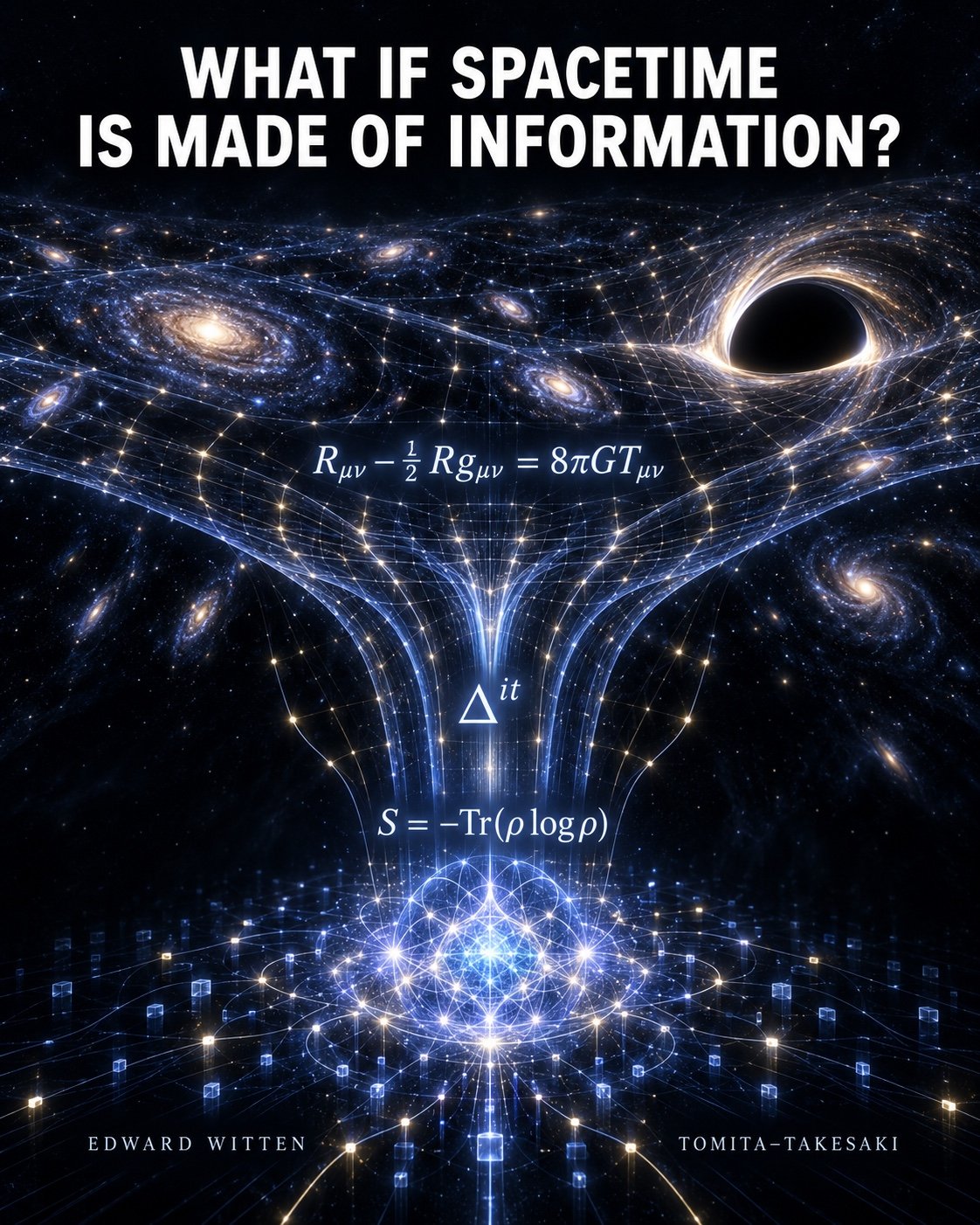
Philipp Dorau and Albert Much show, for a free scalar field, how the relative entropy between the vacuum and a coherent excitation can be related to the energy flux across a local Rindler horizon. Under additional assumptions, this leads to the semiclassical Einstein equations — but it does not prove that gravity is generated solely by quantum information.
Read the full article
In physics, an enormous question is sometimes asked in a very small region of spacetime:
How are quantum information and energy flow related at a local horizon?
Philipp Dorau and Albert Much study this question under carefully specified conditions. They consider a free scalar quantum field, first in the vacuum state and then in a coherent excitation. Roughly speaking, such an excitation can be pictured as a classical-like wave packet carried by the quantum field.
The key result is that the relative entropy between the vacuum and the coherent excitation can be related to the energy flux across a local Rindler horizon, weighted by the corresponding boost energy.
Relative entropy may be understood here as an information-theoretic measure of how distinguishable two quantum states are.
Why does this matter?
In quantum field theory, ordinary entanglement entropy for sharply bounded regions is often problematic. Local algebras of observables do not behave like finite-dimensional quantum systems described by ordinary density matrices.
Relative entropy, however, is well-defined in the algebraic framework. Modular theory also links the vacuum structure of the Rindler wedge to Lorentz boosts.
Does this prove that gravity comes from quantum information?
No. This is the most important limitation of the result.
Dorau and Much first establish a quantum-field-theoretic relation between relative entropy and energy flux. They then use the Bekenstein-Hawking entropy-area relation as an input to connect that flux to a change in horizon area. Through the Raychaudhuri equation, the area variation is related to spacetime curvature.
Together these steps reproduce the semiclassical Einstein equations. But the entropy-area relation is not independently derived by the paper; it is one of the essential assumptions. Spacetime geometry also remains classical while the matter field is treated quantum mechanically.
From Jacobson to quantum relative entropy
The result is nevertheless significant. In 1995, Ted Jacobson showed how Einstein's equations could be connected to a thermodynamic relation applied to local Rindler horizons. Dorau and Much show, in a concrete quantum-field-theory setting, how the "heat" and "entropy" in that argument can be replaced by energy flux and the well-defined Araki-Uhlmann relative entropy.
The paper therefore builds a precise bridge between quantum information and gravity — without yet explaining why spacetime itself should fundamentally emerge from information.
The work was published on 2 March 2026 in Physical Review Letters 136, 091602 (2026).
Connection to my own work
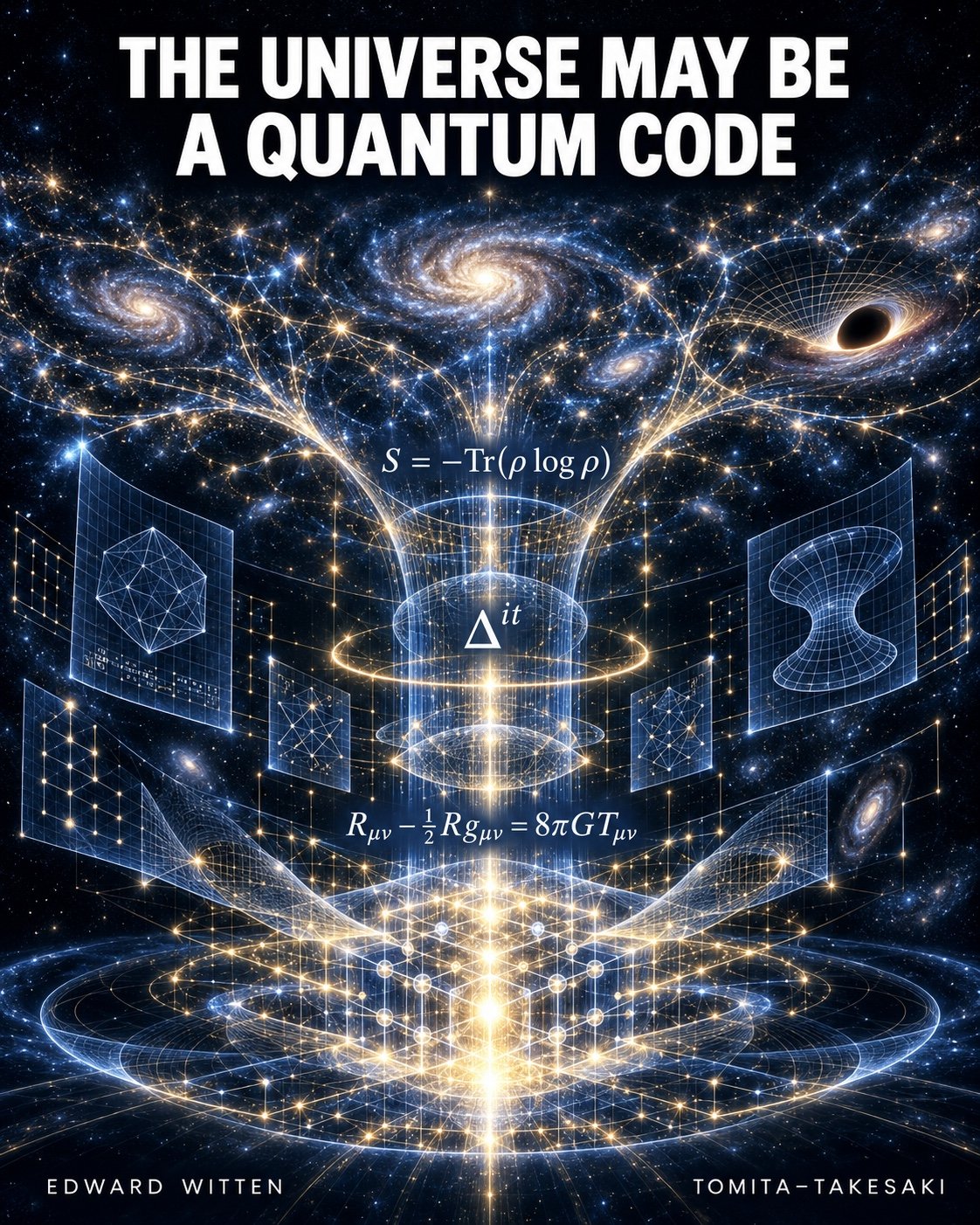
Although the work of Dorau and Much and my own work arrive at different results, they meet on the same mathematical and theoretical line. Modular theory, relative entropy, AQFT and Witten's crossed product are central concepts on this shared foundation.
Using these tools, Dorau and Much investigate how relative entropy can be connected to the semiclassical Einstein equations. My own work instead explores how modular geometry, physical accessibility and stable sectors within larger mathematical structures may be understood.
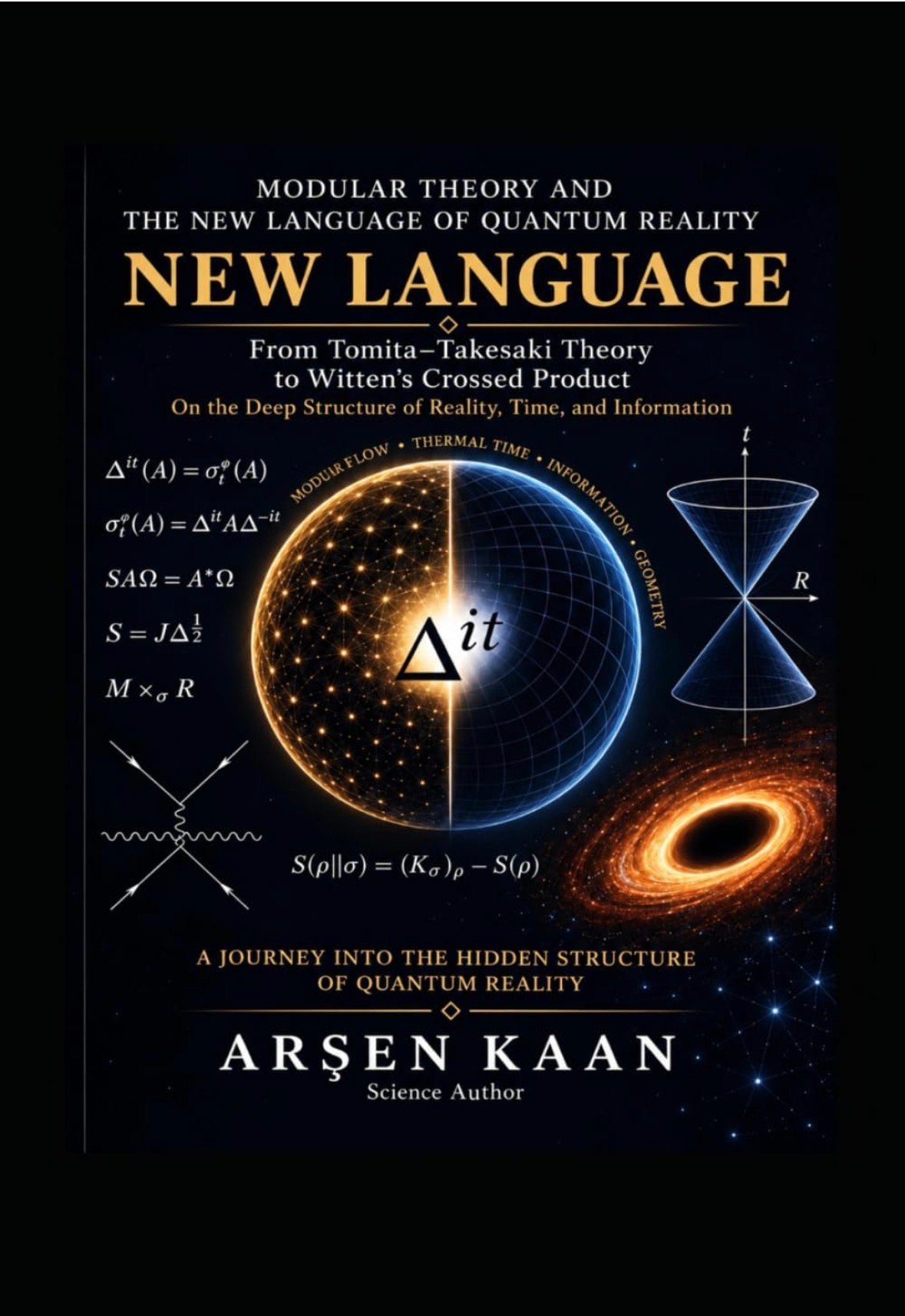
This is why my book sits directly within this discussion: it develops the mathematical language from Tomita–Takesaki theory to Witten's crossed product and examines the deeper background behind these questions. Our questions are different, but the theoretical horizon toward which they point is closely related.
MODULAR THEORY AND THE NEW LANGUAGE OF QUANTUM REALITY
From Tomita–Takesaki Theory to Witten's Crossed Product — On the Deep Structure of Reality, Time, and Information
If you follow these topics, ask questions, read my work and discuss these ideas, you are part of this journey too. Research ideas are shaped not only by published papers, but also by the people who examine them, challenge them and push them forward with new questions.
Arşen Kaan
Source
Philipp Dorau & Albert Much, "From Quantum Relative Entropy to the Semiclassical Einstein Equations", Physical Review Letters 136, 091602 (2026). DOI: 10.1103/lmq8-nsty.